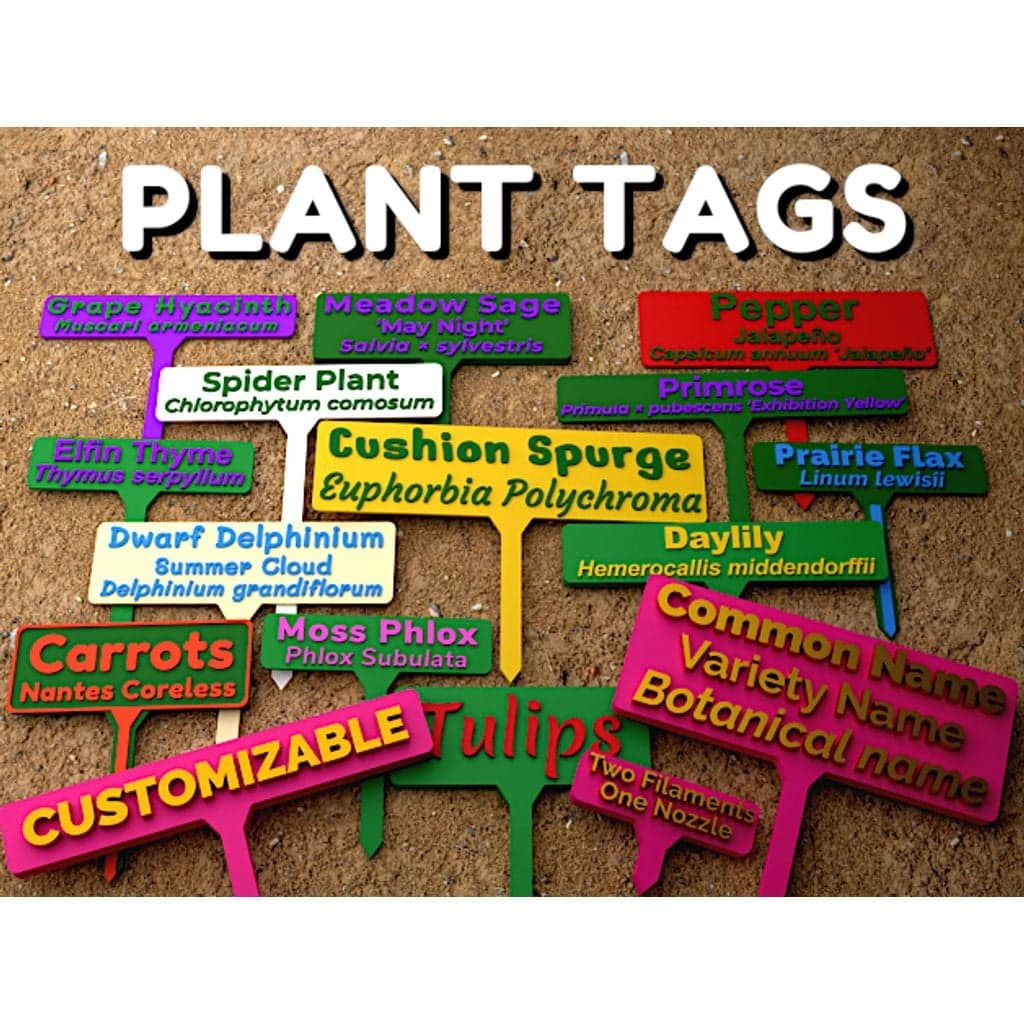
This is a simple OpenSCAD customizer for creating a plant tag. Print them for your flower garden, your vegetable garden, and your indoor houseplants.
There is a small selection of font families to choose from and you can also use any other fonts. You can specify the tag dimensions and font size. You can specify the common name, the variety name, and the botanical name and the placement will automatically adjust if you dont enter all of those names. Depending on the font, the placement might not be very good, so you can fine tune the placement if needed.
2021-03-14 update: V1.1 has a parameter for specifying the length of the stake (stick). 2021-04-28 update: V1.3 has an optional ridge reinforcing the stick and an optional border around the label area. 2022-02-28 update: V1.4 has a parameter for specifying the width of the stake (stick).
Running the Customizer
Thingiverse hadnt run their customizer queue from Jul 10, 2020 to Aug 4, 2022 and may stop running it at any time again, so if they dont process your customized job, you will have to install and run OpenSCAD (free software) on your own computer to process the code to create your own customized models. See DrLexs instructions linked below for further details.
[How to Run Customizer on Your Own Computer](
You can use any font available on your system. The OpenSCAD Help=\Font List menu item shows what fonts are available. Most of the fonts listed in the drop-down selection for this thing can be downloaded from: [Google Fonts repository](
To make a font available to OpenSCAD you have three options: 1) Install the font to the system. The procedure for installing system fonts is dependant on what operating system and what version you are using (Ubuntu Linux 16.01, Ubuntu Linux 20.04, Windows 7, Windows 10, Mac Os 9, Mac Os X, etc.). If you dont know how to install a font on your system then search the web for instructions. 2) Add the font file to your fonts folder, creating the folder if it doesnt already exist. On Linux this would be something like /home/Yourusername/.fonts and on Windows 10 it would be something like C:/Users/Yourusername/.fonts. 3) Add the font to the folder that contains the OpenSCAD file that you want to use the fonts. You will also have to add to the OpenSCAD file the use command substituting the filename of the font for fontname.ttf.
Close OpenSCAD if it was open while you were making the font available and then relaunch it after you have installed/added the font.
For additional details, see the Using Fonts and Styles section on the following page:
Dual Colors with a Single Extruder
Printing multiple colors with a single extruder is really easy.
I printed my dual-color prints with a single extruder by pausing the printer after the tag part had completed and before the text layers had started and then swapping in a spool of a different color of filament. My printer doesnt support the M600 pause command so I have to pause it manually. The printer shows me the height its at while its printing and as soon as it finishes tag body (the layer at 1.0 mm, by default) I pause it using the menu on the printer control panel.
Most printers support the M600 G-code command, so you may be able to add pauses in using your slicer program. You may find the Colorprint tool useful if your printer supports the M600 command, but your slicer doesnt support adding pauses:
After switching filament colors, the nozzle may not be primed and the first bit printed may be under-extruded, so to compensate for this, I always add in a little cylindrical tower and get the slicer to start the layers on that tower. For Cura, the settings that control this are Layer Start X and Layer Start Y, which are in the Travel section. I put the cylinder above the top right corner and set Layer Start X and Layer Start Y to a high number like 500. Ive included a 6 mm tall swap tower, which can be used for any tags with a body less than 6 mm in thickness.
Swapping Filaments: When changing filament, I never yank the old filament out as that seems like such a harsh action to inflict on my printer and if Im doing it while the printer is paused mid-print I dont want the extruders moved even the slightest. Instead, I cut the filament off where it enters the extruder and just start a load filament process on the printer. It extrudes the filament left inside the extruder and I just feed in the new spool of filament following it. If you use this method be very careful to not cut any wires.
For the best looking tags, youll want the top infill area of the tag body part of the model to be a single continuous solid print from one corner to the other, instead of going around the areas where the letters will be added in later layers. To accomplish this in Cura, set the Skin Expand Distance to a high number like 10.
- Some of My Designs
Click an image below (opens in a new tab) or go to my designs page and see them all.
If you see some thing that you like, please click the Like button and turn that heart red.
Источник: https://www.thingiverse.com/thing:4793066
Автор: Lyl3
Другие модели автора
Все моделиСкачать Настраиваемые метки растений — 3D-модель для печати на 3D-принтере
Скачать Настраиваемые метки растений — 3D-модель для печати на 3D-принтере. Файл загружен автором Katalog3D на маркетплейс Каталог3Д и доступен для скачивания в формате STL или 3MF.
Лицензия. Перед использованием ознакомьтесь с условиями лицензии в карточке модели. Одни файлы разрешают только личную печать, другие — коммерческое использование. Подробнее — в разделе лицензии.
Смотрите также: другие модели этого автора, похожие файлы по тегам — houseplants, plants, сад, gardening, plant, Plant Label, houseplant, plant tag.